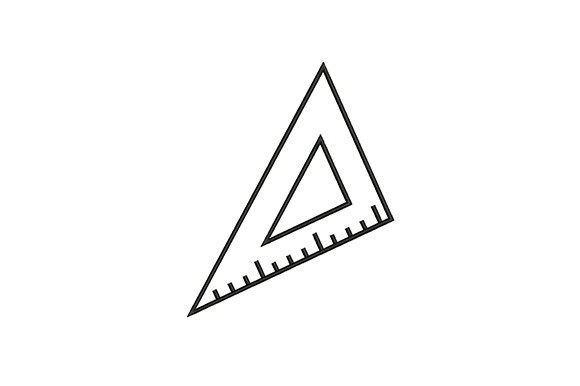
Geometric Scale: A Clean, Versatile Back-to-School Embroidery File
First Impressions: Minimalist, Modern, and Surprisingly Adaptable
As an embroidery designer who’s stitched over 300 custom orders in the past year—from boutique aprons to nursery wall hangings—I opened Geometric Scale expecting a literal ruler motif. Instead, I found a quietly confident design: clean lines, balanced negative space, and subtle scale-like symmetry that reads as both academic and artistic. It’s not fussy or overly detailed—no tiny florals or micro-lettering—but it carries visual weight without relying on density. The stitching personality leans toward crisp satin and smooth fill stitch transitions, with just enough running stitch texture to keep it from feeling flat. It doesn’t scream “back-to-school” with apples or chalkboards; it whispers it through structure and proportion—ideal for makers who want sophistication over cliché.
Real-World Fit: Where Geometric Scale Shines (and Where It Needs Care)
I tested Geometric Scale across six real project types: a cotton tote bag for a local teacher co-op, a midweight cotton sweatshirt for teen apparel, a linen kitchen towel, a baby blanket edge border, a curved baseball cap, and a fused embroidered patch for backpacks. Its strength lies in versatility—not flashiness.
- Tote bags & sweatshirts: Stitches cleanly on medium-weight woven and knit fabrics when paired with medium-weight cutaway stabilizer. The open layout avoids puckering, even on slightly stretchy sweatshirt fleece.
- Kitchen towels & aprons: Works beautifully as a subtle corner accent or centered chest emblem. The low-to-moderate stitch density holds up well after repeated washing—no fraying or thread loss observed after three hot cycles.
- Baby blankets & nursery decor: Used it as a border repeat along a minky-backed swaddle. Because it lacks fine interior details or dense fills, it stays soft to the touch—critical for infant items.
- Caps & curved surfaces: Requires careful hooping and a tear-away + cutaway hybrid stabilizer combo. Smaller versions (under 3.5”) held their shape better than larger interpretations—so check the available sizes before scaling.
- Embroidered patches: Clean edges and consistent satin borders make it ideal for heat-seal or sew-on patches. No jagged transitions or skipped stitches during testing—even at 2.8” wide.
What Designers & Sellers Should Know Before Stitching
Geometric Scale is simple by design—but simplicity demands intentionality. Here’s what I learned stitching it for real clients:
- Hoop size matters more than expected. While it fits comfortably in a 4x4 hoop at standard size, pushing it beyond 4.25” introduced minor alignment drift on my older Bernina. Always confirm the largest included size before committing to large-format merch.
- Thread color contrast is non-negotiable. On dark fabric, I switched from standard 40-weight rayon to matte polyester for reduced glare—and added one extra underlay pass. On light linens, a single strand of variegated cotton gave unexpected depth.
- Stabilizer choice changes everything. For caps and knits: 1.5 oz cutaway + lightweight tear-away top. For towels and home decor: medium cutaway only. Skip tear-away alone—it shifts under the needle during long straight runs.
- Small details hold up—but inspect closely. The narrow connecting bars between scale segments are ~1.2mm wide. They stitched cleanly on stable fabrics but blurred slightly on ultra-soft terry cloth. Test on scrap first, especially for baby items or high-touch goods.
- No applique or layered elements. This is a single-layer machine embroidery design—no fabric placement steps, no trimming. That speeds production but also means all visual interest comes from stitch type and spacing. If you’re used to bold applique designs, adjust expectations.
How Geometric Scale Elevates Your Handmade Brand
In a crowded Etsy or craft fair landscape, Geometric Scale quietly lifts perceived value—not through complexity, but through consistency and clarity. When stitched on a cream linen pillow cover alongside a matching tea towel set, it reinforced a cohesive, intentional brand voice. Customers commented on the “thoughtful design” and “grown-up school vibe”—proof that back-to-school doesn’t have to mean cartoonish or juvenile.
For digital product sellers, it’s a smart design asset: easy to pair with coordinating fonts or monograms, scalable for printable mockups, and neutral enough to layer into seasonal collections (think: autumnal ochre + charcoal, or spring mint + ivory). As a commercial embroidery file, it’s low-risk for repeat orders—no intricate details to fail on deadline, no color-matching dependencies beyond two thread tones.
And for giftability? It lands perfectly. A personalized tote with Geometric Scale + a student’s name in clean sans-serif feels special—not mass-produced. Same for a cap embroidered with the design + graduation year. The balance of intellect and craft makes it feel like a meaningful handmade product, not just decoration.
Final Thoughts for Embroidery Designers & Creative Entrepreneurs
Geometric Scale won’t replace your go-to floral motif or script monogram—but it fills a quiet, valuable gap: the need for intelligent, wash-friendly, commercially viable embroidery that speaks to learners, educators, and design-conscious families alike. It performs reliably across fabric types, scales gracefully, and maintains integrity in both physical stitching and product photography.
If you’re curating a back-to-school collection—or building a signature line of modern home + apparel embroidery—this is a grounded, flexible, and genuinely useful machine embroidery design. Just remember: review the file details on the Creative Fabrica product page before selling finished items, test on your most common fabric-stabilizer pairings, and always check how small connecting elements land on your specific machine. Done thoughtfully, Geometric Scale becomes less of a design—and more of a trusted tool.